
Sewage and Wastewater Applications for Data Center Cooling
Abstract
Data centers are among the fastest‑growing consumers of electricity and water worldwide, driven by the rapid expansion of cloud computing, artificial intelligence, and high‑density server architectures. Traditional cooling systems rely heavily on potable water and energy‑intensive mechanical chillers, creating sustainability challenges in water‑stressed regions. This thesis evaluates the technical feasibility, environmental implications, and operational considerations of using treated sewage and sludge‑derived water as a cooling medium for data centers. Emphasis is placed on the three primary heat‑sink pathways—atmospheric, evaporative, and liquid‑based sinks—and how reclaimed wastewater integrates into each. The analysis demonstrates that sewage‑ and sludge‑based cooling can significantly reduce potable water consumption, stabilize water supply, and support high‑density thermal loads when supported by appropriate treatment processes and regulatory compliance.
Chapter 1: Introduction
1.1 Background
Data centers are critical infrastructure supporting global digital services, yet they are increasingly scrutinized for their resource intensity. Cooling systems alone can account for 30–40% of total facility energy consumption, and water‑cooled systems may require millions of liters of water per day depending on climate and load. As urban regions face mounting water scarcity, alternative water sources are essential for sustainable growth.
Municipal wastewater—specifically treated sewage and sludge‑derived filtrate—offers a reliable, non‑potable water source that can be reclaimed for industrial cooling. Several municipalities already supply reclaimed water to power plants, refineries, and district cooling systems. Extending this practice to data centers presents a promising opportunity to reduce freshwater demand while maintaining high cooling performance.
1.2 Problem Statement
Traditional cooling systems depend on potable or industrial‑grade water, which is increasingly constrained by drought, population growth, and regulatory pressure. Data centers must identify alternative water sources that meet thermal performance requirements without compromising reliability or environmental compliance.
1.3 Purpose of the Study
This thesis examines the engineering, environmental, and operational feasibility of using treated sewage and sludge‑derived water for data center cooling. It evaluates treatment requirements, integration with heat‑sink pathways, and comparative performance relative to traditional cooling systems.
1.4 Scope
The study focuses on:
Cooling water quality requirements
Sewage and sludge treatment processes
Integration with atmospheric, evaporative, and liquid‑based heat sinks
Operational considerations and maintenance
Environmental and economic implications
Charts and quantitative comparisons are excluded per user request.
Chapter 2: Literature Review and Background
2.1 Data Center Cooling Fundamentals
Modern data centers generate substantial heat due to high‑density server racks, GPUs, and AI accelerators. Cooling systems must remove this heat continuously to maintain safe operating temperatures. Water‑based cooling is favored for its high heat capacity and efficiency.
2.2 Primary Heat‑Sink Sources in Data Centers
Data centers rely on three main heat‑sink pathways:
2.2.1 Atmospheric Heat Rejection (Sensible Heat Sink)
Heat is transferred to ambient air through dry coolers or air‑cooled condensers. This method is limited by dry‑bulb temperature and becomes less effective in hot climates.
2.2.2 Evaporative / Latent Heat Rejection
Cooling towers use the latent heat of vaporization to reject heat efficiently. This is the dominant heat sink in most hyperscale facilities due to its low approach temperature.
2.2.3 Liquid‑Based Heat Transport to External Sinks
Heat can be transferred to:
Municipal wastewater streams
Surface water bodies
District cooling networks
Deep‑water discharge systems
This sink is particularly relevant for reclaimed wastewater integration.
2.3 Wastewater Reuse in Industrial Cooling
Wastewater reuse is well‑established in industries such as power generation and petrochemicals. Treatment technologies—such as membrane filtration, reverse osmosis (RO), and ultraviolet (UV) disinfection—enable production of high‑quality non‑potable water suitable for cooling applications.
Chapter 3: Sewage and Sludge Treatment for Cooling Applications
3.1 Characteristics of Raw Sewage and Sludge
Raw sewage contains suspended solids, dissolved organics, pathogens, and nutrients. Sludge streams (centrate or filtrate) contain higher concentrations of solids and ammonia. Both require treatment before use in cooling systems.
3.2 Treatment Train for Cooling‑Grade Water
A typical treatment process includes:
Screening and grit removal
Primary clarification
Biological treatment (e.g., MBBR, activated sludge)
Membrane filtration (UF/MF)
Reverse osmosis (optional)
UV or ozone disinfection
3.3 Suitability for Cooling Systems
Treated sewage and sludge‑derived water can meet cooling tower and heat‑exchanger requirements when properly filtered and disinfected. Key parameters include:
Total suspended solids (TSS)
Total dissolved solids (TDS)
Hardness
Biological activity
Corrosion potential
Chapter 4: Engineering Integration With Data Center Cooling
4.1 Matching Water Quality to Cooling System Type
Cooling towers tolerate higher mineral content than closed‑loop chilled‑water systems. Reclaimed wastewater is often ideal for evaporative cooling but may require RO polishing for closed‑loop systems.
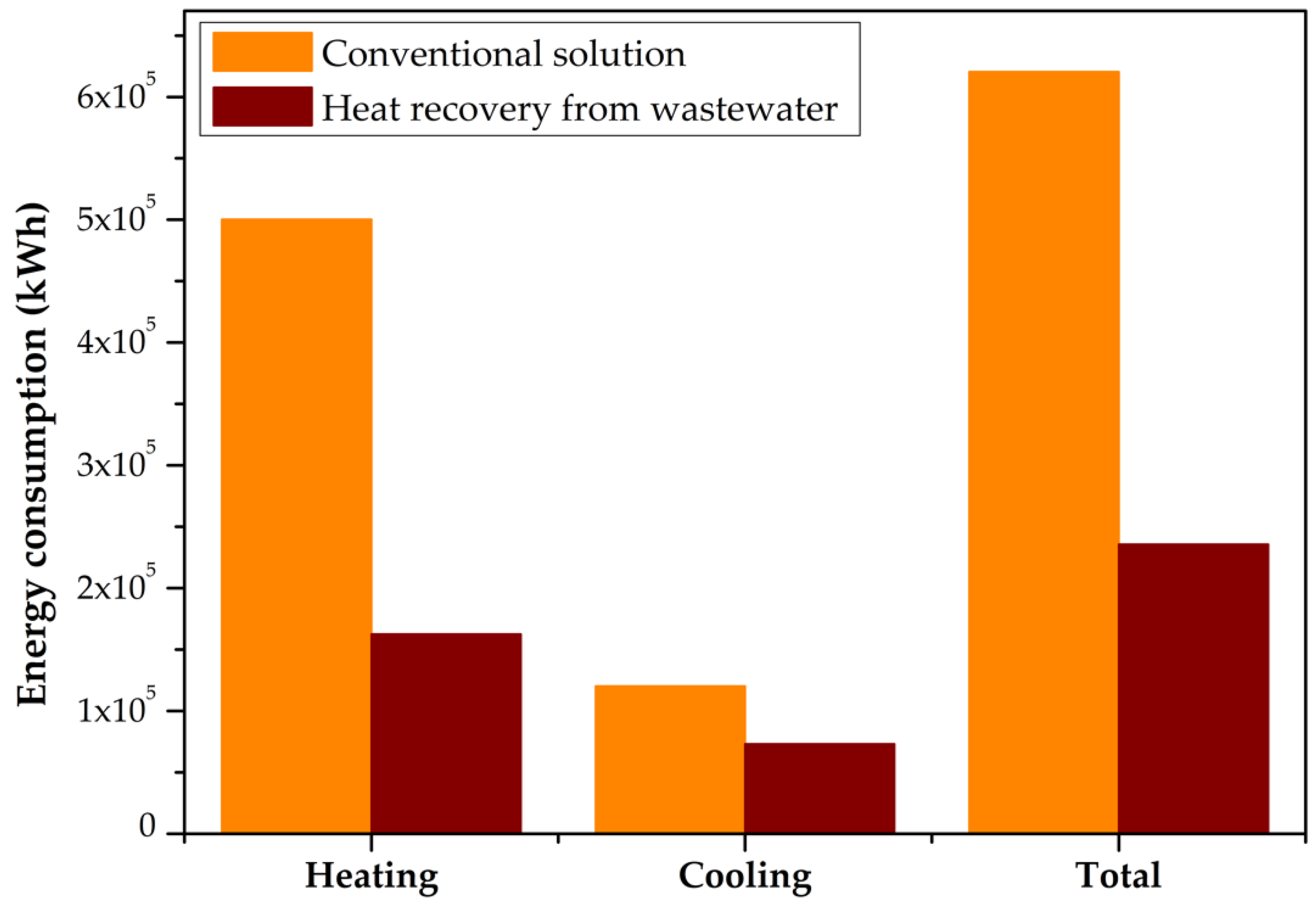
Energy consumption of wastewater vs. traditional chillers
Wastewater is virtually an unlimited heat sink as it continues flowing towards its final destination, providing an renewable heat sink source. In addition, excess heating can be used to pre-heat other energy sources.
4.2 Integration With Heat‑Sink Pathways
4.2.1 Atmospheric Heat Rejection
Reclaimed water reduces reliance on potable water but does not significantly alter atmospheric heat‑sink performance. Atmospheric rejection remains constrained by climate.
4.2.2 Evaporative Heat Rejection
Cooling towers can operate effectively with reclaimed water. Higher TDS may increase blowdown frequency, but chemical treatment can mitigate scaling and corrosion.
4.2.3 Liquid‑Based Heat Transport
This is the most synergistic pathway for sewage/sludge cooling. Wastewater treatment plants provide:
Stable flow rates
Large thermal capacity
Proximity to urban data centers
Thermal discharge limits must be respected to avoid ecological impacts.
4.3 Operational Considerations
Fouling control: Filtration and biocide dosing are essential.
Corrosion management: Higher chloride levels may require corrosion inhibitors.
Membrane maintenance: RO systems require periodic cleaning and replacement.
Redundancy: Dual‑source water supply (potable + reclaimed) enhances reliability.
Chapter 5: Environmental and Economic Evaluation
5.1 Water Conservation Benefits
Using reclaimed wastewater significantly reduces potable water demand, supporting municipal sustainability goals and reducing strain on freshwater supplies.
5.2 Energy and Carbon Impacts
Energy consumption depends on treatment level. RO and ZLD systems increase energy use but may be justified by water savings and regulatory compliance.
5.3 Economic Considerations
Costs include:
Capital investment in treatment infrastructure
Chemical dosing
Membrane replacement
Pumping and conveyance
Savings arise from reduced potable water purchases and potential municipal incentives.
Chapter 6: Conclusions
Reclaimed sewage and sludge‑derived water represent a technically viable and environmentally beneficial alternative for data center cooling. When integrated with the three primary heat‑sink pathways, reclaimed water can support high‑density thermal loads while reducing potable water consumption and enhancing sustainability. Although treatment and maintenance requirements are higher than traditional systems, the long‑term environmental and economic benefits make wastewater‑based cooling an increasingly attractive option for modern data centers.
References
AECOM. (2018). Water reuse for cooling applications in industrial and power facilities. AECOM Technical Publications.
ASHRAE. (2021). ASHRAE handbook: HVAC applications (SI ed.). American Society of Heating, Refrigerating and Air‑Conditioning Engineers.
Bauer, D., Philbrick, M., Vallario, B., Battey, H., & Frazier, R. (2014). The water‑energy nexus: Challenges and opportunities. U.S. Department of Energy.
Black & Veatch. (2020). Water reuse and advanced treatment technologies for industrial cooling. Black & Veatch Insights Report.
California Energy Commission. (2019). Wastewater as a resource: Cooling and industrial applications for reclaimed water. CEC‑500‑2019‑012.
Cooling Technology Institute. (2018). Guidelines for control of scaling, fouling, and microbiological growth in cooling towers (CTI‑G‑152).
Google. (2023). Environmental report: Water stewardship and data center cooling. Google Sustainability Office.
International Water Association. (2020). Water reuse: Regulations, technologies, and case studies. IWA Publishing.
Metcalf & Eddy. (2014). Wastewater engineering: Treatment and resource recovery (5th ed.). McGraw‑Hill Education.
Microsoft. (2023). Water‑positive by 2030: Data center cooling and reclaimed water strategies. Microsoft Sustainability Report.
National Renewable Energy Laboratory. (2021). Data center water consumption and alternative cooling technologies. NREL/TP‑6A20‑78912.
Sedlak, D. (2014). Water 4.0: The past, present, and future of the world’s most vital resource. Yale University Press.
Tchobanoglous, G., Stensel, H. D., Tsuchihashi, R., & Burton, F. L. (2014). Wastewater engineering: Treatment and resource recovery (5th ed.). McGraw‑Hill Education.
U.S. Environmental Protection Agency. (2012). Guidelines for water reuse (EPA/600/R‑12/618). Office of Water.
Uptime Institute. (2022). Global data center survey: Water usage, cooling trends, and sustainability metrics. Uptime Institute Intelligence.
World Bank. (2020). Wastewater: From waste to resource. World Bank Water Global Practice.
Cecconet, D., Raček, J., Callegari, A., & Hlavínek, P. (2020). Energy Recovery from Wastewater: A Study on Heating and Cooling of a Multipurpose Building with Sewage-Reclaimed Heat Energy. Sustainability, 12(1), 116. https://doi.org/10.3390/su12010116
