
An “Arm-less” Race
Agilis Consulting is a versatile company that offers traditional engineering services, but also some product development, prototyping, and R&D support. Book an appointment and get free, that’s right, absolutely free coffee. Now back to your originally scheduled blog reading after this brief advertising message.
Drone technology has evolved into one of the most versatile and fast‑moving fields in modern engineering, blending aerodynamics, sensors, autonomy, and advanced materials into compact flying systems that can do far more than most people realize.
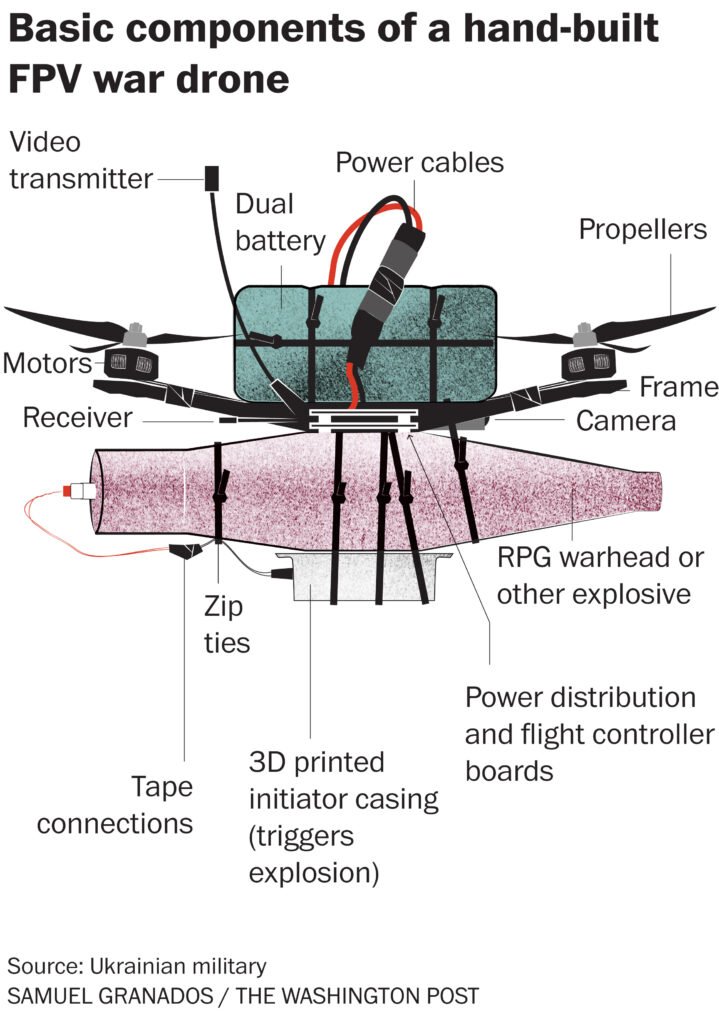
There are five general categories or systems in a drone system.
Airframe
Lightweight composite structures for strength and maneuverability
Vibration-absorbing materials to stabilize sensors and reduce noise, typically augmented by air gaps in the structure for air dampening effects (weakness 1)
Propulsion
Brushless motors (weakness 2) driving propellers at high RPM
Thrust generated by rotor speed differences controls lift, pitch, roll, and yaw
Quadcopters use opposing rotor directions to cancel reactive torque
Navigation & Control
GPS modules for positioning (resolved weakness through the use of fiber optic cables in the battlefield)
IMUs (gyroscopes + accelerometers) for stability (weakness 3)
Remote ground control stations or fully autonomous onboard computers (weakness 4…cyberwarfare or some electronic warfare either active or passive)
Sensors & Payloads
High‑resolution cameras
Infrared sensors
LiDAR, radar, and multispectral imaging for industrial applications
Weapons including rudimentary trigger explosives like grenades
Software & Autonomy
Real‑time flight control algorithms (weakness 5 through zero-day vulnerabilities or “fuzzing”)
Obstacle avoidance
Autonomous mission planning
Sensor fusion for stable flight in complex environments
In the context of the battlefield, there are many weaknesses for drone technology that can be used to counter swarms without wasting expensive missiles and large amounts of ammunition. The unfortunate aspect of drone defense is the kamikaze nature of the income drone itself, similar to the risks of shooting down a missile with an interceptor. It will simply come down at some location and perhaps within an urbanized area. However, the goal is neutralization of command-and-control function, and ultimately an untimely demise of the weapon system over an unoccupied open field.
Let’s discuss the 5 major weaknesses.
Introduction of critical frequencies through various means like explosives with a broad shockwave range in an area rendering all drones structurally compromised. These are build from thin body frames or unsophisticated, mass produced builds could be out of polymers.
Brushless motors are notoriously susceptible to dirt due to the extremely small air gap (fractions of a millimeter) and can cause rubbing on the rotor, especially if the debris is conductive or metallic. Obviously, physical blockage along air cooling paths can cause overheating.
Accelerometers are piezo-electric devices that respond to vibration with a voltage signal proportional to its calibration configuration. The sensitivity is very high and would not take much to disrupt, especially if the drone is heavily dependent on these sensors for flight.
Remote ground control stations are very susceptible to signal warfare on open communications (unencrypted). In an active electronic warfare capacity, signals would be disrupted ever so slightly to avoid an opposing force from catching on to the significant failures in the battlefield.
The fun zero-day vulnerabilities! This weakness is nearly impossible to resolve because it involves “fuzzing”, which is a technical method in which the testers intentionally feed random or junk inputs to trigger software crashes and unexpected behavior. Basically, the same thing as glitch hunting in a video game for speedrunning (I can write about that on a subsequent blog if you’re interested).
There is quite a significant amount of detail into each of these countermeasures, but when employed effectively, there could be a multi-layered, defense-in-depth approach to drone swarm mitigation, otherwise overwhelmed by conventional weapon systems. It is partially an economic assessment because defensive weapons systems are much more sophisticated and require complex computational models with self-modifying features to adjust in the field within milliseconds.
